Mewgenics Breeding Guide: How to Play God (And Win)
Every cat in Mewgenics carries two gene slots for each trait, and the one you can't see is usually the one that ruins a bloodline later.
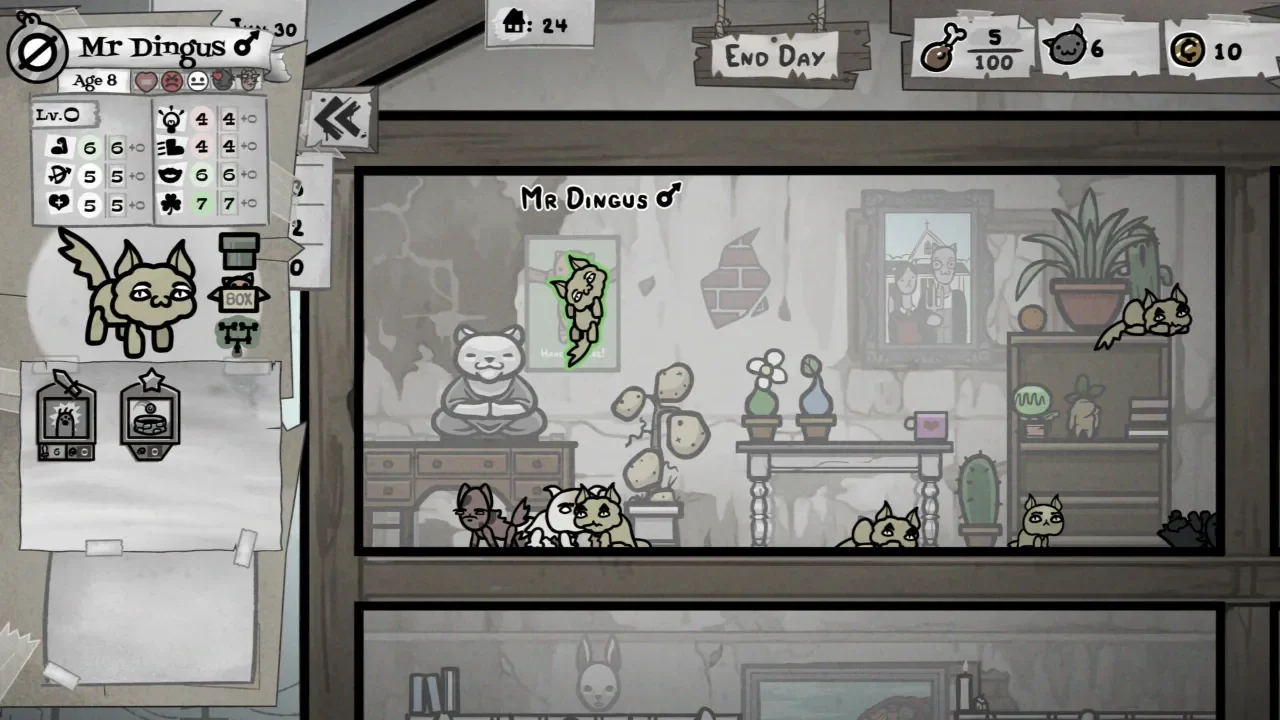
Breeding in this game isn't the "put two cats in a room and hope" system it looks like on the surface. It runs on actual Mendelian genetics, hidden recessive traits, and a defect system that punishes careless inbreeding hard. Treat it casually and the result is a house full of frail, small-brained cats that drop dead of a heart attack at age four. Treat it like a system to be managed and it starts producing exactly the cats you want.
How Genes Actually Work Here
Every trait, whether it's a body part or a color, comes from two gene slots, one inherited from each parent. A dominant gene (capital A) overrides everything else. One copy is enough to show up visually, so a cat with even a single dominant gene for a Triangle Head will have a Triangle Head, full stop.
Recessive genes (lowercase a) work differently. They only show up if a cat inherits two copies (aa). This is exactly why two normal-looking cats can breed and produce a kitten that looks nothing like either parent.
The real danger is the "carrier" cat: a cat that looks completely normal (Aa) but is quietly holding a bad recessive gene. Breed two carriers together and there's a 25% chance of producing a defective kitten (aa). Early on, there's no way to see genes directly, so the only real diagnostic tool is test breeding. If a pairing produces a dud, one of the parents is carrying something bad. Mark it, separate it, or cut it from the program.
Shape Decides Class, Not Just Looks
Head shape, body shape, and tail shape all feed directly into a cat's stats and class aptitude, which makes appearance a genuine gameplay stat instead of cosmetic flavor.
Triangle heads push Mana and Intelligence, making them natural Mages, though that comes with being squishy. Square heads lean into Defense and HP, the obvious Tank pick. Round heads land in the middle, fine for Rogues or generalists but not standouts anywhere.
Body shape stacks on top of that. Slender bodies boost Speed and Evasion, which suits Rogues or any glass cannon build. Fat bodies add HP and Defense, and pairing a fat body with a square head builds about as tanky a cat as the game allows. Average bodies don't do much of anything and are worth skipping when there's a choice.
Tail shape rounds it out. Long tails extend ability range, which matters a lot for Mages and Archers. Stubby tails increase knockback, useful for a Tank looking to shove enemies into environmental hazards. Curly tails boost carry capacity, which is really only relevant for a dedicated loot mule.
Matching shape to role isn't optional flavor here. A Triangle-headed Mage in a Fighter collar is wasted potential, and a mismatched squad just performs worse across the board.
The House Stats Actually Matter
Before touching any individual cat, the icons in the top left corner of the house screen need attention, since they govern breeding frequency and kitten quality across the board. These get manipulated by buying furniture from Baby Jack and placing it in the right rooms.
Comfort works like a libido meter. High comfort means cats breed more often, low comfort means they fight instead.
Stimulation is the single most important stat here. High stimulation raises the odds a kitten inherits the better stats from its parents. Low stimulation just regresses toward the mean, meaning mediocre babies.
Health keeps disease away. Low health means constant bouts of Pox or Runny Nose, while high health can actually cure existing defects over time.
Mutation is a gamble stat. It raises the odds of random new traits, including elemental powers, but also raises the odds of physical deformities.
Appeal determines the quality of strays that wander in. Anyone tired of garbage strays should upgrade this first.
Stacking Stimulation is the highest priority of the five if only one gets attention early, since it directly controls whether good parent stats actually make it to the next generation.
Inbreeding Is Sometimes the Right Call
Yes, the game lets a mother breed with her own son, and there's a real strategic reason to do it. Inbreeding is the fastest way to lock in a recessive gene as a guaranteed trait. If a cat has a rare recessive mutation like Fire, breeding it back with a parent is the quickest path to making that trait permanent instead of a coin flip.
It's not free. Every generation of inbreeding raises the defect chance by roughly 15%, and the possible outcomes aren't minor:
Fragile Bones, which doubles incoming damage.
Hemophilia, where bleed effects never stop on their own.
Sterile, which ends that bloodline entirely.
The workable approach is a strict one-and-done rule. Inbreed for exactly one generation to lock a trait or shape, then immediately breed out with an unrelated stray to reset the defect counter. Pushing it to two or three generations in a row is how a run ends up with a cat that can barely function.
Tink Turns Guesswork Into Data
Tink, who lives in the green pipe, is the information engine behind all of this. Sending him kittens levels up breeding tech and removes a lot of the guesswork.
His first upgrade reveals base stats, which matters because a level 5 cat can look strong while its actual base stats, the ones it passes to offspring, are mediocre. Without this, it's easy to breed the wrong "good-looking" cat. The second upgrade reveals the family tree, which helps avoid accidental inbreeding before it happens. The third reveals sexual orientation, which sounds like a joke upgrade but saves real time, since pairing two cats who can't produce a litter together is just a wasted night.
Kittens that aren't going to make the roster shouldn't sit around eating food. Sending them to Tink immediately keeps the breeding program moving instead of stalling on hoarded mediocrity.
Culling Is the Actual Skill Here
Space and food are both limited, which means keeping every kitten born isn't an option. Anything with stats sitting under 6 across the board, a negative nature like Lazy or Cowardly, or a shape mismatch such as a Square Head paired with a Slender Body, needs to go, whether that's off to Tink or just released outright.
Holding onto a mediocre cat "just in case" doesn't help. It eats into food, takes up a roster slot, and drags down the average quality of the gene pool sitting in the house.
A Neverstone Fixes the XP Problem
Post-battle experience gets distributed automatically, and the game tends to funnel it toward whichever cats are lowest level. That's a problem when a disposable stray keeps siphoning XP away from the main combat squad.
A Neverstone solves this. Using one on a throwaway stray locks that cat out of leveling entirely, which forces all the XP from a battle toward the cats actually meant for the long haul. Strays become pure placeholders instead of accidental XP thieves.
The Nursery Environment Shapes Traits Too
Genetics aren't the whole story. What's happening around a kitten at birth influences its starting traits directly. Classical music near the crib raises the odds of the Calm trait, which suits Healers well, while Heavy Metal pushes toward Aggressive, better for Warriors. Placing Glowing Barrels in the nursery raises Mutation Rate by 50%, though it raises Defect Rate right along with it. Cleanliness matters too. A dirty nursery significantly raises the odds of the Sickly trait, and a stressed or sick mother tends to produce a worse kitten overall regardless of genetics.
None of these are decorative choices. A nursery set up with the right music and a clean litter box is doing real work on the next generation before a single gene gets rolled.
Building a genuinely strong lineage in Mewgenics isn't a one-run project. It's incremental: a better head shape here, a point of Strength there, spread across generations of cats that mostly exist to get sorted, culled, or bred out. It stings the first time a decent-looking kitten gets checked, found wanting, and sent down the pipe. By the fiftieth time, it just reads as optimization.