Mewgenics House Guide: Interior Design for Mad Scientists
Furniture in Mewgenics doesn't decorate a room, it recalibrates the machine that produces your next generation of cats.
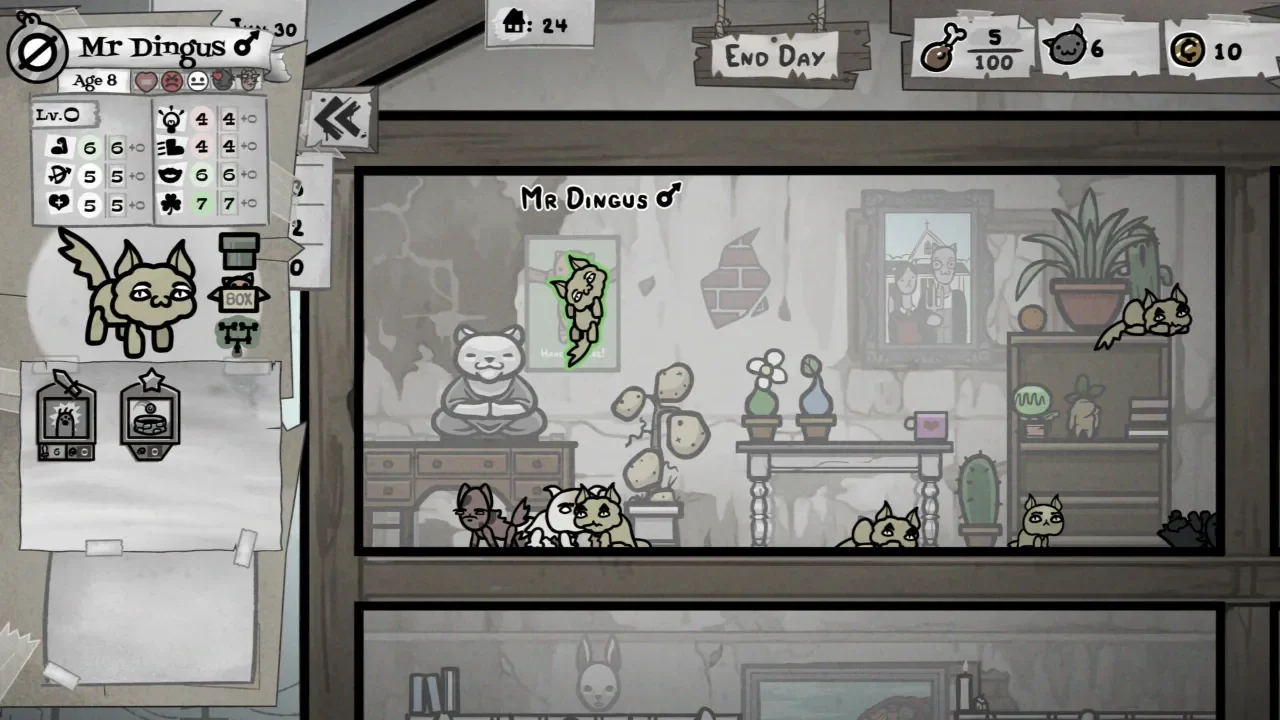
A rug that "ties the room together" does nothing here. Every chair, lamp, and radioactive barrel placed in the house shifts one of five underlying stats, and those stats quietly decide whether cats breed, fight, get sick, or mutate into something with the wrong number of legs. Treating the house as decoration instead of infrastructure is how a Comfort stat ends up in the floor and a promising bloodline stalls out entirely.
Five Stats Run Everything
The game tracks Appeal, Comfort, Health, Mutation, and Stimulation for the house as a whole, and every piece of furniture nudges at least one of them.
Comfort keeps the peace. High Comfort means cats breed instead of fight, and letting it slide turns the house into a gladiator pit. Stimulation is the stat that actually matters for breeding quality, since high Stimulation raises the odds a kitten inherits the good traits from its parents rather than regressing toward mediocrity. Health governs recovery from injury and disease, and a dirty, neglected house tanks it fast. Mutation is the wildcard, capable of producing genuinely useful elemental powers or straightforward deformities depending on the roll. Appeal determines the quality of strays that wander in on their own, so a house with low Appeal mostly attracts cats not worth keeping.
None of these stats work in isolation, and most furniture forces a trade-off rather than a clean upgrade.
Comfort and Stimulation Fight Each Other
A lot of the best Stimulation furniture, like a Toxic Waste Barrel, comes at the direct cost of Comfort. Stack too many of those in one room and the result is a house full of highly mutated cats who are also furious all the time and not breeding because of it. Balancing that out means mixing in the boring stuff, cushions, microwaves, anything that quietly props Comfort back up, so a room can push for weird genetics without collapsing into constant infighting.
Splitting rooms by purpose helps here too. A house maxes out at five rooms total, and dedicating one specifically to breeding, stacked with Stimulation furniture and just enough Comfort furniture to keep the peace, works better than spreading every stat evenly across a single crowded space.
Food Storage Deserves Early Priority
The default food cap sits at 100, which disappears fast once a house fills up with cats. Furniture that raises that ceiling, like Food Storage upgrades, is worth buying the moment it's available. A higher cap means stockpiling enough food to focus on breeding for weeks without being forced back out on a risky supply run just to keep everyone fed.
Baby Jack Restocks Every Sunday
Baby Jack runs the furniture store, and his inventory refreshes on in-game Sundays. That's worth tracking deliberately, since hoarding gold through the week specifically to buy him out on reset day gets more value than spending as money trickles in. He gets unlocked after clearing the Cave region, and from that point forward, spare gold has a clear job.
The Tube Isn't Cruelty, It's Currency
The tube sitting to the side of the house is where unwanted cats go, and while shoving a cat down a pipe sounds harsh, donating to the NPCs on the other end is the only route to permanent upgrades. Each one wants something specific, and sending the wrong cat just wastes the trip.
Frank takes retired cats and builds new rooms, capping out at five total. He's worth prioritizing early since more rooms mean more room to actually separate breeding stock from everything else.
Butch also wants retired cats, and pays out in item storage capacity, useful for hauling more loot back from increasingly dangerous zones.
Baby Jack wants injured cats specifically. A cat that comes home missing an eye or limping is exactly what he's after, and feeding him enough of them upgrades the furniture store itself.
Tink only takes kittens around one year old, and unlocks UI tools like family trees, stat views, and a way to check compatibility between potential breeding pairs. A dud kitten with bad stats is better sent to him than kept around eating food.
Dr. Beanies wants mutated cats and unlocks side quests in return. He's the right destination for anything that came out of the breeding room with three ears or a tail on fire.
Sorting cats by what each NPC actually wants, rather than dumping whoever's nearest into the tube, is the difference between steady upgrades and wasted trips.
Overcrowding Kills More Cats Than Bosses Do
Every room has a capacity limit, and going over it tanks Comfort directly, which cascades into fighting and disease spreading through the house. The fix isn't complicated, it just requires being willing to act on it. Old cats, injured cats, and cats carrying bad genes need to go, whether that's into the tube toward an NPC or off the roster entirely. Holding onto a mediocre cat out of sentiment costs food, costs room capacity, and drags Comfort down for everyone else sharing that space.
None of this is about building a house that looks good. It's about keeping five specific dials tuned well enough that the cats living there actually breed, recover, and produce kittens worth keeping instead of quietly falling apart around a suspiciously nice rug.