Slay the Spire 2 Fake Merchant Guide: Exploiting the Bootleg Market
Stumbling into a knockoff shop in Act 3 looks like a joke at first glance, until it turns out to be one of the most profitable optional encounters in the entire game.

Most people walk into this room, see budget relics with question marks in their names, assume it's a troll, and walk right back out. That's leaving real value on the table. The Fake Merchant is a legitimate, fully optional opportunity, and understanding both his discount inventory and one very specific trick involving a consumable item can turn this weird little room into a genuine power spike.
Spotting the Imposter Before Walking In
The game doesn't flag this encounter obviously, so it's easy to miss entirely if the background art isn't getting a second look. The telltale signs are all visual rather than textual. The merchant sprite itself sits noticeably larger than the real shopkeeper's model. The candles scattered around the tent are oversized in a way that reads as artificial rather than decorative. The usual "Sale" sign hanging in a normal shop is conspicuously absent. And the background music is a subtly off-key version of the standard shop theme, close enough to blend in on a first listen but wrong on close attention.
Spotting those cues is worth a pause before committing to anything, especially checking current gold and potion belt contents, since what happens next depends heavily on both.
The Discount Inventory Is Better Than It Looks
The imposter doesn't sell standard cards or removal services. His entire stock is weakened knockoff relics priced at roughly a quarter of what the real versions cost in a normal shop. Yes, the effects are genuinely watered down, a 4 Block Anchor knockoff is nowhere near as strong as the real 10 Block version, but at that price point they're a remarkably efficient way to patch up a shaky deck without draining the wallet.
The Merchant's Rug — does nothing at all, purely a joke item.
Heart of Iron??? — grants 7 Plating.
Anchor??? — starts every combat with 4 Block.
Venerable Tea Set??? — grants 1 additional Energy on the first turn after resting.
Strike Dummy??? — adds 1 damage to any card containing Strike.
Lee's Waffle??? — heals 10% of max HP immediately on pickup, a solid cheap heal in a pinch.
Blood Vial??? — heals 1 HP at the start of every combat.
Orichalcum??? — grants 3 Block if a turn ends without any Block already up.
He also offers a choice between three upgraded cards. If there's spare gold sitting around, grabbing a handful of these is a genuinely efficient use of it. There's also a way to skip paying for any of it entirely, provided the right item's already in the inventory.
Throwing a Foul Potion at Him Starts a Fight
The Foul Potion is a fairly common consumable that normally just deals 12 damage when thrown at an enemy. Thrown at a normal merchant, it's a harmless joke that actually earns 100 gold as a reward for the gag.
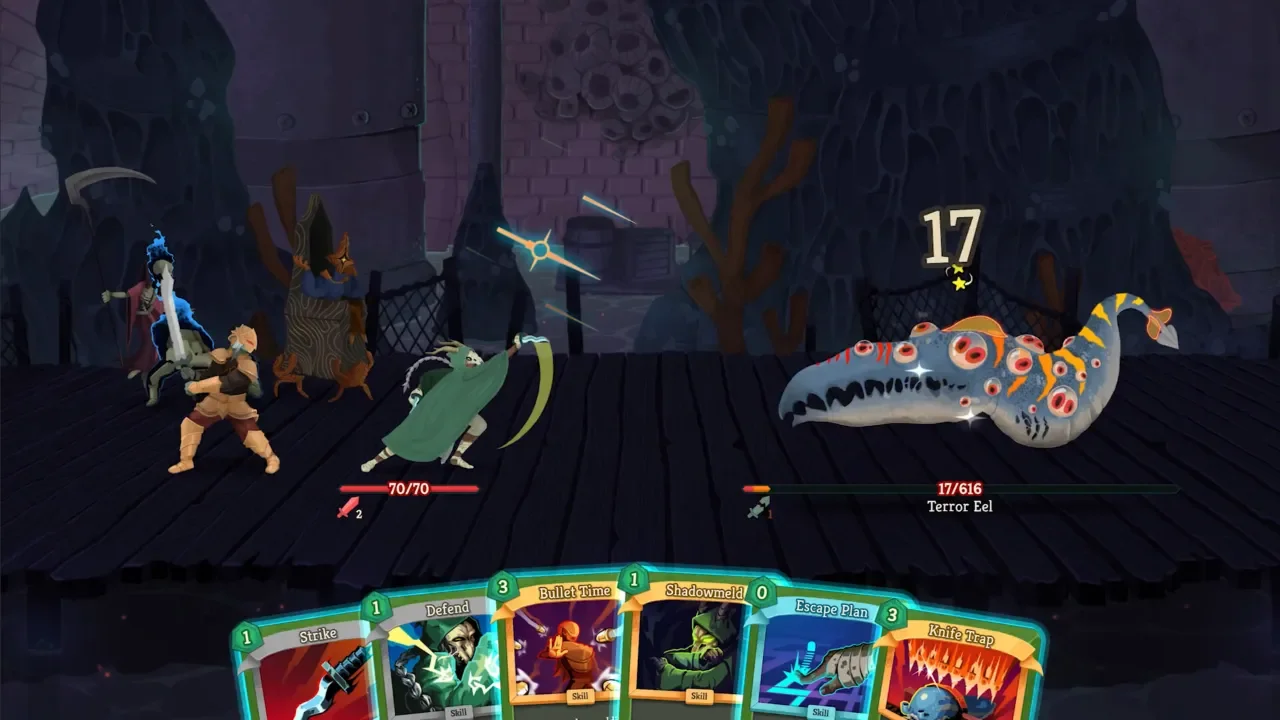
Thrown at the Fake Merchant specifically, the reaction is completely different. He drops the act immediately, turns hostile, and starts a fight on the spot, right in the middle of his own shop. This isn't a trivial fight either. He's scaled to roughly the difficulty of an Act 3 Elite, bordering on an easy Boss, and hits hard enough that going in unprepared on a high Ascension run is a real risk. Knowing how much incoming damage the current deck can actually absorb before picking this fight matters more the further up the difficulty ladder a run's climbed.
What Winning Actually Pays Out
Beating him down inside his own shop is absurdly generous. The reward is 300 gold plus his entire remaining inventory of bootleg relics, handed over for free, on top of a standard card reward screen featuring upgraded options. Walking away with six or seven relics in one shot, even the weakened versions, is a serious spike in passive power.
The best part is that these knockoffs stack cleanly with their full-strength counterparts rather than replacing them. Already running a real Anchor and picking up the fake one on top means starting every fight with 14 Block instead of 10. Stack a real Orichalcum with the fake version and passive defense turns into a genuine safety net rather than a marginal bonus.
The catch is entirely about setup. Finding a Foul Potion, committing a potion slot to carrying it all the way into Act 3, and then actually rolling the Fake Merchant on a random event node all have to line up, and that takes a fair amount of patience across a run or several. When it finally does come together, though, robbing this guy for his whole inventory is one of the more satisfying payoffs available outside of a straightforward boss fight.