What Does Influence Actually Do In All Will Fall?
Staring at a growing pile of a glowing currency while your colony slowly starves to death is a uniquely frustrating experience.
Survival city builders are notorious for throwing multiple resources at you simultaneously, but All Will Fall takes it to a genuinely baffling level with its Influence system. The tutorial glosses over it so quickly that you would be forgiven for thinking it was a placeholder mechanic for early access. You gather this resource passively, watch the number tick up on your screen, and search the standard build menus for something to spend it on. When you find nothing, you assume it is useless.
That assumption will eventually get your entire population killed. Influence is arguably the most powerful tool you have for manipulating the simulated economy and dealing with the game's brutal random events. The problem is that the developers buried the actual buttons you need to click. I spent my first major run completely ignoring Influence, only to watch my carefully planned horizontal foundations rot because half my workforce decided to go on strike.
The Hidden Policies Tab
The biggest crime the user interface commits is hiding the policy management screen entirely out of your natural line of sight.
Locating The Menu
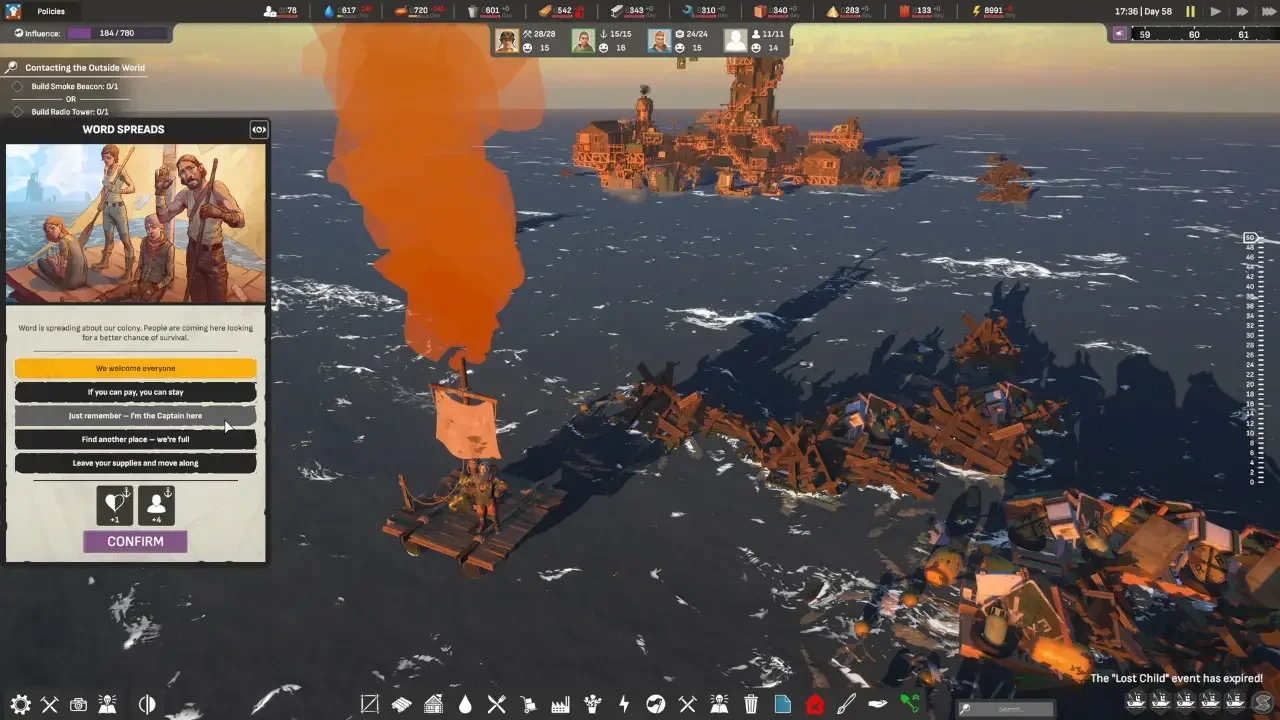
If you mess around with the HUD during the early game, you might accidentally stumble across it. The Policies tab is tucked away at the very top left corner of your screen. This is your primary outlet for spending Influence, and it completely alters the baseline rules of your colony. You use your banked Influence here to enact sweeping laws that apply to your entire population.
Understanding Policy Trade Offs
Policies are rarely a free buff. They usually come with a catch, forcing you to choose what kind of dystopia you want to run. Some are straightforward, like a policy that makes food and water generate slightly more happiness per consumed unit. That is a fantastic safety net if your basic production loops are struggling to keep up with demand.
Other policies require a much harsher trade off. You can spend Influence to mandate a massive happiness boost across your colony, but in exchange, the global movement speed of your citizens plummets. I only enact those heavy trade off policies when I am desperate. Lowering movement speed destroys your logistical efficiency, but if it stops a colony wide strike, it is a price you have to pay.
Surviving Random Events
All Will Fall relies heavily on random narrative events to ruin your day. Influence is your get out of jail free card.
Bypassing The Punishment
As you play, the game will present you with text based scenarios. A group of starving survivors might show up begging for entry, or a massive structural failure might require an immediate fix. The default options for these events are usually brutal. You either drain your hard earned resources or take a massive hit to your faction morale.
If you have a stockpile of Influence, new options appear. You can spend your currency to force a better outcome. There are scenarios that are incredibly resource intensive to resolve normally, but dropping a chunk of Influence bypasses the cost entirely. I had an event involving a traveling trader where the default trade deals were absolute garbage. Because I had Influence saved up, the game gave me the option to simply rob the trader blind. It is a harsh world, and Influence lets you be the one holding the gun.
The Power Of Overtime
This is the mechanic that saved my most recent playthrough from total collapse.
Forcing The Issue
You can manually spend Influence to force any specific job in your colony to work overtime. When you are staring down the barrel of an incoming storm and you desperately need ten more metal scrap to reinforce a load bearing wall, standard production speeds will not cut it.
I used this extensively once I finally unlocked the boat that gathers metal from the deep water. The base gathering rate was agonizingly slow, and the tide was threatening to rise. I burned my Influence to force the boat crew into overtime, artificially speeding up their collection rate just long enough to grab what I needed. It is a brilliant tactical tool for bottleneck situations.
Faction Morale And The Threat Of Strikes
You have to manage your Influence carefully because you need your citizens to stay happy.
The Separate Faction Trackers
Your colony is not a single, unified group. The Workers, Sailors, and Engineers all track their morale completely independently. You can have a settlement where your Workers are perfectly content, but your Engineers are furious. You need to monitor all three groups constantly.
Morale plummets when you fail to provide the basics. If you are short on food and water, or if you expand your population without building enough residential housing, the happiness meters will tank.
The Consequence Of Failure
If you let morale drop too low, you do not just get a warning notification. The angry faction will go on strike. They completely stop working. They refuse to carry materials, they abandon their production stations, and your entire supply chain halts immediately. If your food producers go on strike, everyone starves, which drops morale further, triggering more strikes. It is a death spiral that is incredibly difficult to recover from.
The Magic Number
You want to keep everyone fed and sheltered not just to avoid strikes, but to unlock the game's built in rewards. Pay close attention to the number 30. The most significant production bonuses in the game unlock automatically when a faction hits 30 happiness.
If you can keep their basic needs met and use your Influence on the right policies to pad their stats, you hit that 30 happiness threshold. Suddenly, your factories are churning out materials at a premium rate, making the entire struggle to survive just a little bit easier to manage.