Crimson Desert Gambling Guide: How to Win Duo and Five-Card
Crimson Desert's gambling minigames run on numbered sticks instead of cards, and the AI running them has a flaw ruthless enough to turn a night at the table into your fastest source of silver in the game.
I lost an embarrassing pile of copper to a smuggler in Hernand before I figured out what was actually going on under the hood. Once it clicked, the games stopped being a mystery and started being a printing press.
The Flaw That Makes These Games Worth Playing
The AI opponents get reckless during the opening round of any match. Deal yourself anything decent, above Five Points in Duo, or a Pair in Five-Card, and going all in immediately tends to bait the table into matching your bet on hands that shouldn't call at all. It's not unusual to see three or four opponents dump their entire stack on turn one holding nothing worth the risk. Save manually before you sit down, and if a miracle hand somehow beats you, just reload and try again. The AI tightens up considerably in later rounds, folding and checking its way through the rest of the match, so dragging things out past the first hand mostly just wastes time.
Where to Actually Sit Down
Not every table plays the same game, and the buy-in scales hard depending on which town you're in.
The number of opponents at any given table is randomized daily too, so a session can swing between a quiet one-on-one duel and a full four-player table without warning. Hernand's 15 silver entry is low enough that most people can scrape it together on their own, but if you're walking into this completely broke, there are quicker ways to build up a starting bankroll than picking flowers for an hour first.
Duo Runs on Simple Addition
Duo ignores color entirely and cares only about numbers. You're dealt five sticks, and the first job is picking three that add up to exactly 10, 20, or 30. Fail to hit one of those totals and the hand busts automatically.
Group three sticks correctly and they get discarded, leaving the remaining two as your actual hand. A pair of 10s beats everything outright. A standard pair, any two matching numbers from 1 to 9, ranks next, with higher numbers beating lower ones. Missing a pair entirely, the next best outcome is a Perfect Nine, where the two sticks sum to exactly 9. Below that, it comes down to Points, the single digit of your two sticks added together, where higher still wins.
Five-Card Adds Color Into the Mix
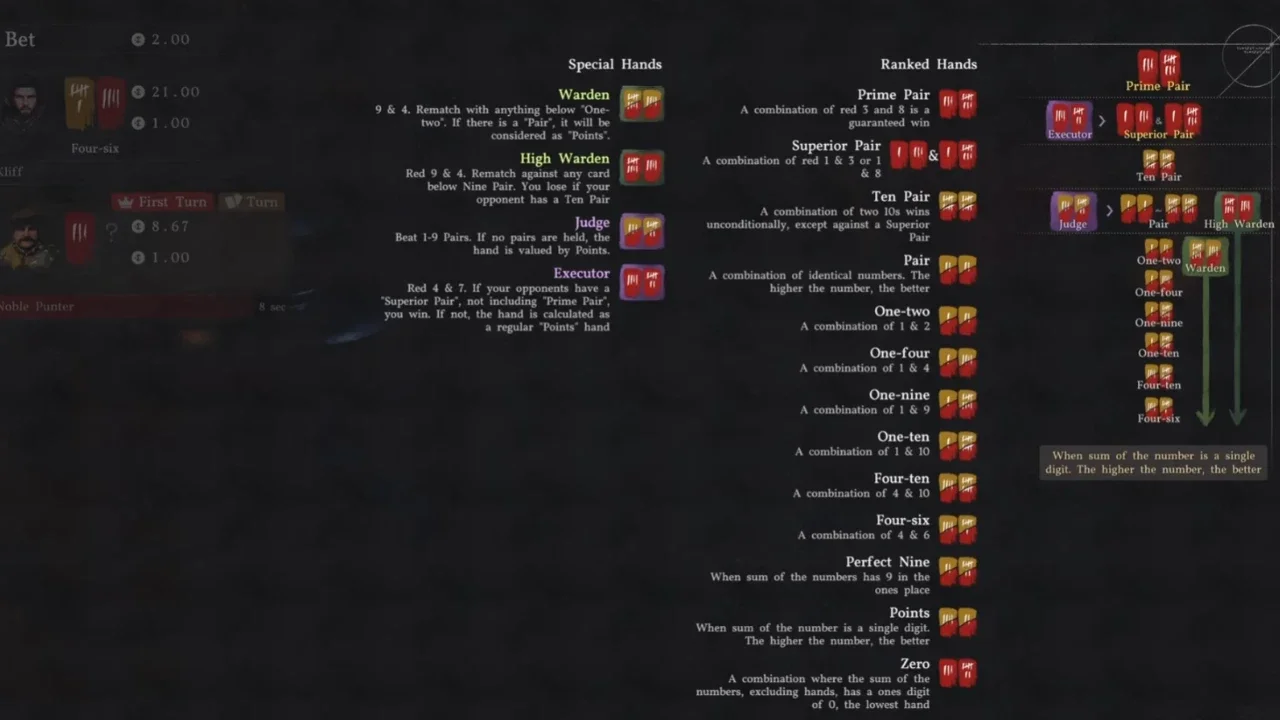
Beighen is the only place to find Five-Card, and it layers red and yellow sticks on top of the same numeric logic, with color combinations deciding the strongest hands outright.
A red 3 paired with a red 8 forms the Prime Pair, an automatic win the moment it lands. A red 1 next to either a red 3 or red 8 forms the Superior Pair, the next rung down. After that the game drops back to color-blind rules: a Ten Pair beats a standard pair of any color, and failing both of those, One-plus Combinations take over. Holding a 1 alongside another number ranks in descending order, 1 and 2 first, then 1 and 4, then 1 and 9, then 1 and 10.
Five-Card also has Warden and High Warden hands that force a rematch against a weaker opponent rather than winning outright. They're not worth tracking closely once the AI exploit above does most of the heavy lifting anyway.
Rigging the Deck Once You've Earned It
Combat in Crimson Desert lets you learn enemy moves by watching them, and the same system quietly applies to the gambling tables. Play enough hands against opponents who are cheating and they'll start glowing with a blue outline. Catch that three separate times and the Cheat ability unlocks for good.
From then on, holding the Hide Hand prompt during your own deal pauses the game and lets you plant a specific number and color into your hand. In Five-Card, that means locking in a red 8 and just hoping a natural red 3 shows up to complete the Prime Pair.
When to Accuse the Dealer
Other players cheat too, and catching them requires holding the Accuse button while they're dealing. Guess right and the accused gets forcibly removed from the match, which is as dramatic in motion as it sounds.
Guess wrong, though, and the accusation backfires. The house bans you from that gambling den for a couple of in-game days, annoying but nowhere near as bad as what happens if that aggression spills out into the streets instead. Actual violence against the wrong person carries consequences that don't end with a short ban, so it's worth knowing the difference before Kliff's temper gets the better of him somewhere that isn't a card table.