Edge of Memories Is Still Coming Out, Even Though the Studio That Made It Doesn't Exist Anymore
Midgar Studio, the French developer behind Edge of Eternity and the upcoming Edge of Memories, was liquidated by a French court on July 20, and the game is still scheduled to release later this year anyway.
Nacon, the publisher that bought Midgar in 2022, is majority owned by Bigben Interactive. Bigben missed a payment on an 87.3 million euro bond in February, when its banking pool wouldn't extend further credit with only days left before the deadline. Nacon filed for insolvency days after that, and three more of its studios, Spiders, Kylotonn, and Cyanide, filed their own insolvency paperwork in March. Spiders shut down completely in April.
Midgar itself wasn't caught up in that first wave, and for a couple months it looked fine from the outside. Nacon promoted Edge of Memories at its own showcase in May, and the studio extended the game's Steam Next Fest demo on June 27 like a team that still had a release ahead of it. Behind the scenes, Nacon was quietly trying to find a buyer for Midgar specifically, and when nobody made an offer in time, the court ordered liquidation on July 20, ending the 18-year run founder Jérémy Zeler-Maury started back in 2008.
Who's Actually Finishing It
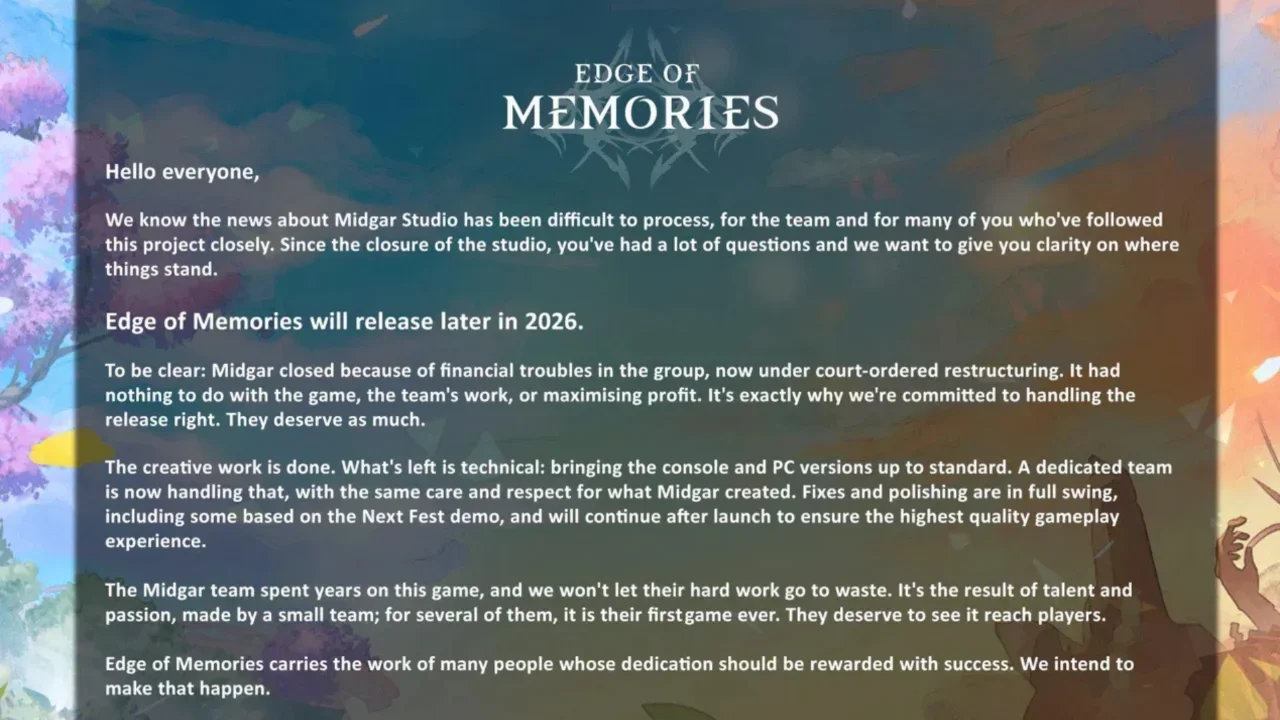
The actual answer comes down to something fairly ordinary in games publishing. Nacon owns Edge of Memories, not Midgar. The studio built it, but the finished assets, the code, and the IP all sit with the publisher, and that ownership is exactly why a developer can stop existing while its last game keeps moving toward release. Nacon's own statement says the creative work is done and what's left is technical, bringing the console and PC builds up to standard and folding in fixes from Next Fest feedback, the kind of polish pass that doesn't actually require the original studio to still be open.
Zeler-Maury, Midgar's founder, is also Nacon's CTO now, having moved up to the parent company at some point before the liquidation. The studio he built is gone as an employer, but he's still inside the building that owns what it made.