Timberborn District Guide: How to Expand Without Starving
Expanding your colony blindly is a fantastic way to accidentally trigger a catastrophic mass starvation event.
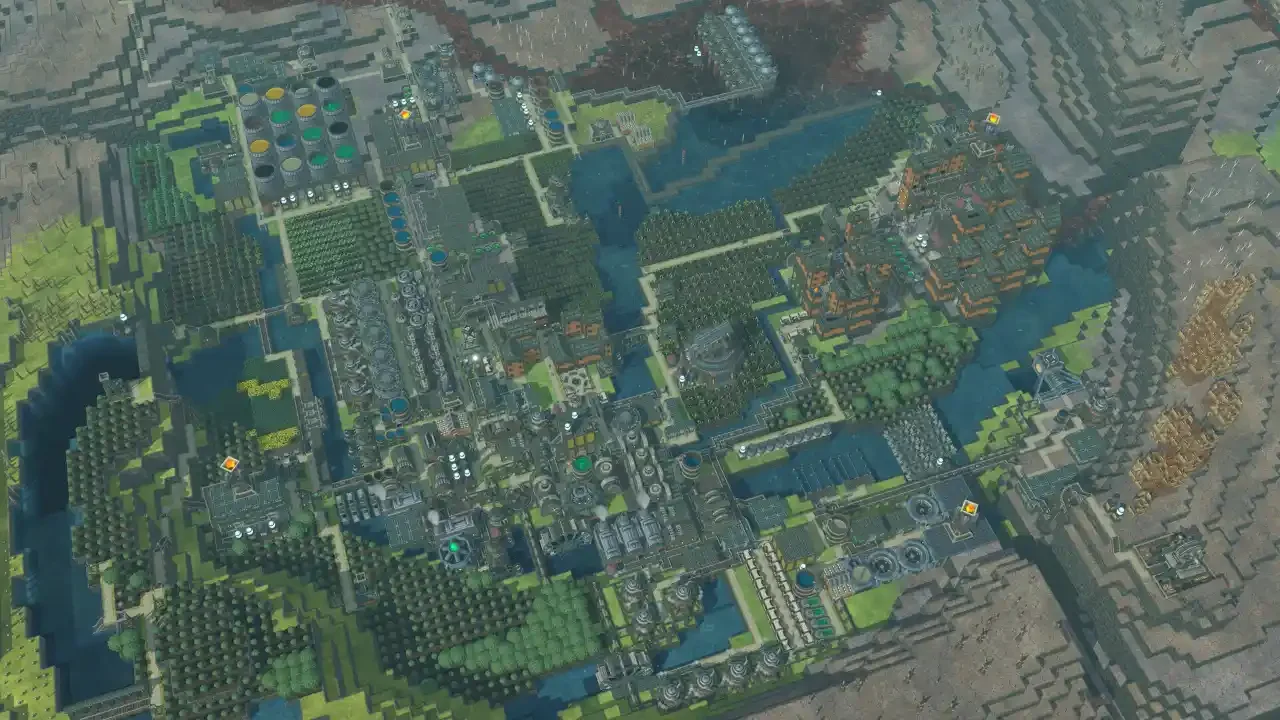
Setting up a second district feels exactly like starting a brand new game, except the stakes are infinitely higher. You finally stabilized your core settlement using my beginner survival blueprint, you have a massive stockpile of carrots, and you think you are ready to conquer the map. Then you drop a new District Center, migrate twenty beavers across the river, and watch them all die of thirst three days later because you failed to establish a functioning supply chain.
I murdered an entire zip code of virtual rodents before I finally understood how district logistics actually operate. Timberborn does not magically share resources across your map. If a potato is sitting in District A, a starving beaver in District B cannot touch it. You have to physically move that potato across the border.
Understanding the Red Line of Death
You cannot simply stretch one massive town across the entire map. The game actively stops you from doing this, and you need to understand why before you try to force it.
Every District Center has a maximum operational range. When you build paths extending outward from the center, you will notice the line changes color. It starts green, fades to yellow, and eventually turns a hard red. The red line marks the absolute limit of your district. If you build a lumber mill or a housing lodge beyond that red line, your beavers will refuse to acknowledge it exists. They will not work there. They will not sleep there.
This range limitation forces you to build decentralized nodes of industry. When you spot a massive scrap metal ruin or a perfect chokepoint for a new automated badtide sluice system that sits outside your current borders, you have no choice but to establish a new district.
The Art of the District Crossing
A District Crossing is the border patrol checkpoint of your beaver empire. It is the only way goods move from one localized economy to another.
You have to build the District Crossing directly between the path networks of your two settlements. Once placed, you assign workers to act as haulers. These specific beavers have one miserable job. They pick up crates of supplies from one side of the border and physically carry them to the other side.
The secret to making this work without micro-managing yourself into a headache is mastering the import and export thresholds. When you click on the crossing, you can select specific goods and dictate exactly how they move. Do not just leave these settings on default.
If your main hub produces all your food, set the crossing to export carrots only when the main hub has more than fifty in storage. Set the new, struggling outpost to import carrots until they have a stockpile of thirty. This prevents your border haulers from draining your primary food supply dry just to fill up a warehouse in the middle of nowhere. It creates an automated buffer that protects your core population while feeding your expansion.
Expansion Strategies
There are two primary ways to start a new settlement. One method requires patience and guarantees survival. The other method is a chaotic gamble that usually ends in a localized apocalypse.
The Mitosis Method
This is the slow, calculated, and highly recommended way to expand. You treat the new district like a parasitic twin until it can survive on its own.
You start by building a District Crossing and placing a new District Center right on the other side. Do not send any beavers over yet. First, use your border haulers to push a massive stockpile of water, food, and building materials into the new territory. Let the warehouses fill up completely.
Only after the supplies are secured do you open the migration panel and send over a small crew of builders. They arrive in a fully stocked safe zone. Their only job is to immediately build local water pumps, a forester, and some carrot fields. Once they secure their own local water and food production, you can cut the umbilical cord. The district is now self-sufficient.
The Brute Force Drop
Sometimes you just need to clear-cut a distant forest or mine a specific scrap ruin, and you do not care about building a permanent town. This is the brute force method.
You build the District Center, drop down a small storage pile, and instantly migrate twenty unemployed beavers to the frontier. You force them to build and harvest as fast as physically possible while living entirely off the limited supplies carried over the border. It is a race against the clock. The moment their food or water runs critically low, you pause the game and migrate the entire population back to the safety of your main hub. It is incredibly risky, completely unstable, and highly effective for smash-and-grab resource operations.
Well-Being and the Workday Hack
Moving goods across massive district lines requires a fast, highly motivated workforce. If your beavers are exhausted, your supply lines will crumble.
I mentioned this briefly in my earlier guides, but it is absolutely critical when dealing with multi-district logistics. You need to reduce your working hours. The default sixteen-hour workday leaves your population with zero time to sleep, socialize, and visit monuments. Fulfilling these basic needs generates Well-Being points. High Well-Being directly translates to massive buffs in movement speed and carrying capacity.
A hauler moving at a baseline crawl will fail to keep your outpost supplied. A hauler running on a fourteen-hour schedule with a belly full of grilled potatoes and a recent visit to a rooftop terrace will sprint across your bridges and keep your empire functioning. Treat your workers well, and they will literally carry your new districts on their backs.
The Floating Population Trick
Old age is a mechanic you cannot avoid. Beavers eventually die. When a critical hauler or water pump operator dies in a newly established, fragile district, the resulting bottleneck can crash the entire local economy before a child grows up to replace them.
Always keep a floating population of five to ten unemployed adult beavers in your primary, safest district. They will happily eat your food and visit your shrines while waiting for a job. Treat them as your emergency reserve. The moment you see a vital position empty out in an expansion town, open the migration menu and send one of your unemployed reserves over to instantly fill the gap.
Once you have mastered the delicate balance of district thresholds and local water supplies, you basically have total control over the map. You can push into the most hostile corners of the wasteland and strip mine the earth for scrap metal. You are going to need every ounce of that metal if you plan on actually finishing a sandbox run.
When you have a fully operational multi-district supply chain humming along, you are finally ready to tackle the ultimate resource sink. Check out my final guide on building the Earth Recultivator and saving the world to see exactly how much industry is required to cure the planet.